

The Comparison
Why Revenue Infrastructure.
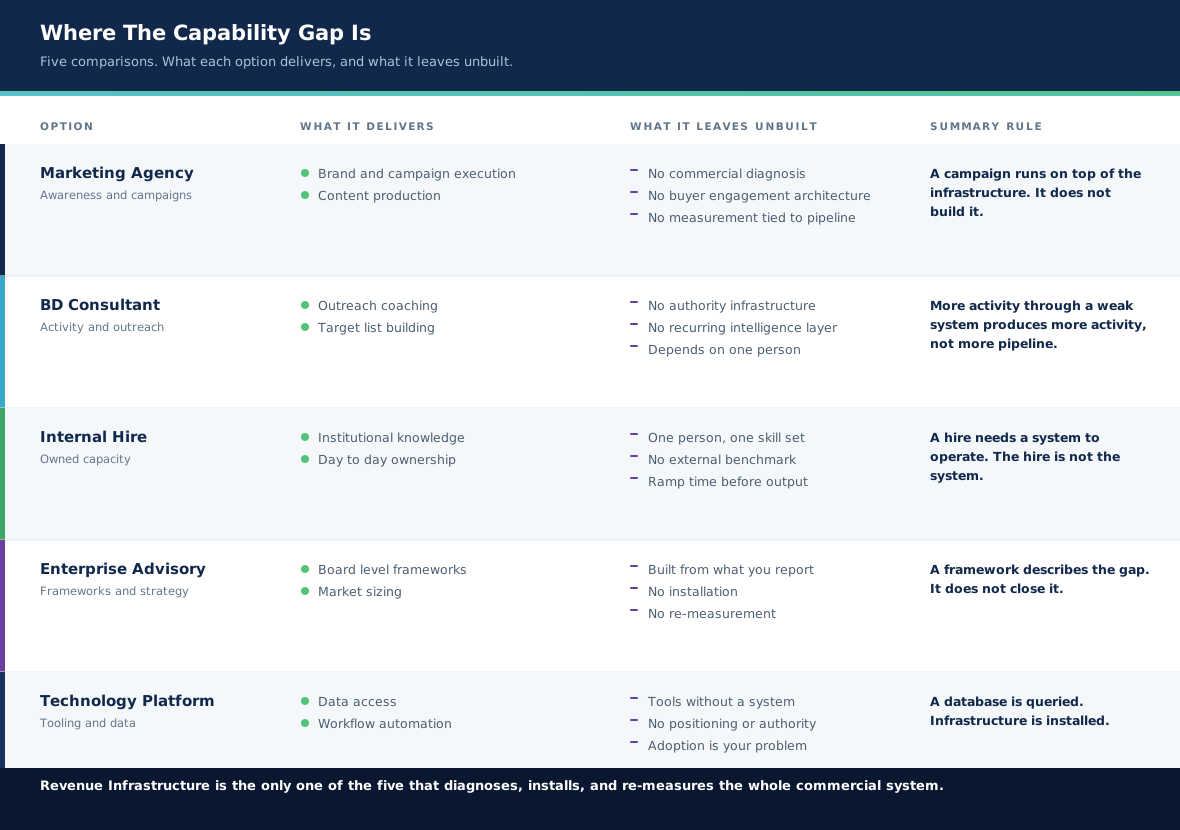
Most life sciences organizations that come to BioAlliance have already tried one of four alternatives. A marketing agency. A BD consultant. An internal hire. Or a large advisory firm. Each of those approaches solves a different problem. None of them solves the infrastructure problem. This page explains the difference.
Five Comparisons
What Each Option Delivers, And What It Leaves Unbuilt.
The Capability Gap
Side By Side.
Comparison 1, BioAlliance Versus The Marketing Agency.
BioAlliance Versus The Marketing Agency
A marketing agency produces awareness. Content, social media, brand identity, and campaign execution. Those are delivery mechanisms. They require an underlying commercial infrastructure to convert attention into pipeline. Without infrastructure, marketing activity produces visibility without conversion. BioAlliance does not produce campaigns. BioAlliance builds the system that determines whether campaigns, outbound activity, and BD conversations produce compounding returns or isolated transactions.
A marketing agency executes inside your system. BioAlliance builds the system.
Comparison 2, BioAlliance Versus The BD Consultant.
BioAlliance Versus The BD Consultant
A BD consultant or outsourced BD firm generates activity. Calls, meetings, conference attendance, and relationship development. That activity is valuable when the infrastructure beneath it can convert it into pipeline. When the infrastructure is missing, BD activity produces conversations that do not advance. When the consultant leaves, the pipeline leaves with them. BioAlliance builds the structural system that makes BD activity compound rather than evaporate. The difference between a BD consultant and BioAlliance is the difference between effort and infrastructure.
A BD consultant drives activity. BioAlliance builds the infrastructure that converts activity into pipeline.
Comparison 3, BioAlliance Versus Building Internally.
BioAlliance Versus Building Internally
Hiring a commercial director or marketing manager to build capability internally is a legitimate long-term strategy. It is also slow, expensive, and difficult to validate. An internal hire takes 12 to 18 months to produce measurable commercial results. The infrastructure they build reflects their individual experience rather than an externally benchmarked standard. There is no peer comparison, no CMR Score, and no diagnostic to confirm whether what they are building is commercially credible. BioAlliance delivers a scored, benchmarked diagnostic within 5 to 7 business days and a prioritized installation sequence based on observable market evidence. Building internally is an investment in future capability. BioAlliance is an investment in current infrastructure.
An internal hire builds capability over time. BioAlliance builds infrastructure now, benchmarked against your market.
Comparison 4, BioAlliance Versus The Enterprise Advisory Firm.
BioAlliance Versus The Enterprise Advisory Firm
McKinsey, Bain, Deloitte, EY, KPMG, Accenture, and Oliver Wyman serve enterprise transformation mandates. When a Fortune 500 pharmaceutical company needs to restructure its commercial organization across 40 markets, those firms are built for that scope. When a CRO CEO needs to understand why pipeline is underperforming and what to install next, those firms produce a framework document based on internal interviews. They do not produce a CMR Score, a peer benchmark panel of five named competitors, or a 90-day installation sequence. BioAlliance is purpose-built for life sciences commercial infrastructure diagnostics at the organizational level where large consultancies do not operate and where the infrastructure gaps have the most commercial consequence.
Enterprise advisory firms serve transformation mandates. BioAlliance serves infrastructure gaps.
Table Footer
Large advisory firms serve enterprise transformation mandates. BioAlliance is purpose-built for life sciences commercial infrastructure diagnostics.
Comparison 5, BioAlliance Versus The Technology Platform.
BioAlliance Versus The Technology Platform
HubSpot, Salesforce, and marketing automation platforms are infrastructure tools. They are not infrastructure strategy. A CRM does not define your ICP, build your authority, or prescribe your buyer engagement sequence. It records activity against a commercial system that must already exist. Organizations that invest in CRM and marketing automation without first building the commercial infrastructure to support them consistently report the same outcome: sophisticated tools producing disappointing results. BioAlliance diagnoses and builds the commercial infrastructure that determines whether your technology investments produce compounding returns or expensive underutilization.
Technology platforms are tools. Revenue Infrastructure is the strategy that determines whether the tools produce results.
The Right Question Is Not Who. It Is What.
Most organizations ask which firm to hire. The more useful question is what type of commercial problem they are actually trying to solve. If the problem is awareness, a marketing agency is the right answer. If the problem is activity, a BD consultant is the right answer. If the problem is transformation at enterprise scale, a large advisory firm is the right answer. If the problem is that the commercial system underneath marketing, BD, and technology is structurally underbuilt, Revenue Infrastructure is the answer. The Revenue Infrastructure Diagnostic identifies which problem you actually have. Everything else follows from that.
The Difference
Revenue Infrastructure Diagnoses, Installs, And Re-Measures.
It is the only one of the five that owns the whole commercial system rather than a slice of it.